|
|
||
|
|
|
 |
|
|
||
|
|
|
|
|
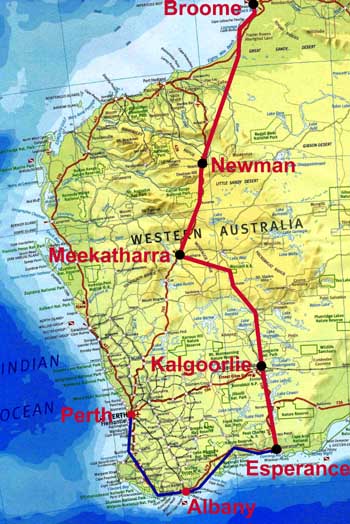
Today, the trip north was about to begin. Before we could take to the air we needed a taxi to get back to the airport. When mentioning that we had a bit of luggage the first statement was that the driver would not lift any luggage whatsoever. Okay, we could live with that, but we never turn down help anymore after 3 shoulder surgeries in three years and one more injury last fall. All went well and soon we were in the air heading north along the lonely road and railroad tracks. The country more green along the coast gradually became more barren. On the map lakes were portrayed but looking outside the cockpit we saw only large flat depressions with sandy or more often, white salt coverings. It was impossible to see any animals from the air, even at very low altitudes. Most likely, they were resting in the shade of the trees and shrubs. Hot does not begin to describe the word, hot in this area. |
|||
 Joan
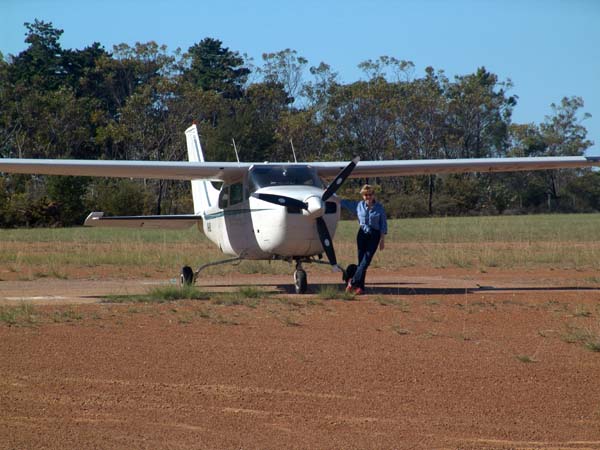
prefights VH-NLB before take off in Esperance Joan
prefights VH-NLB before take off in Esperance |
 The
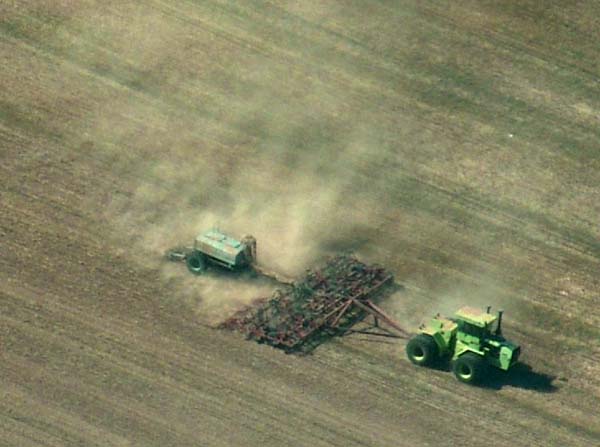
white sands of Esperance has changed to a coarse sandy texture The
white sands of Esperance has changed to a coarse sandy texture |
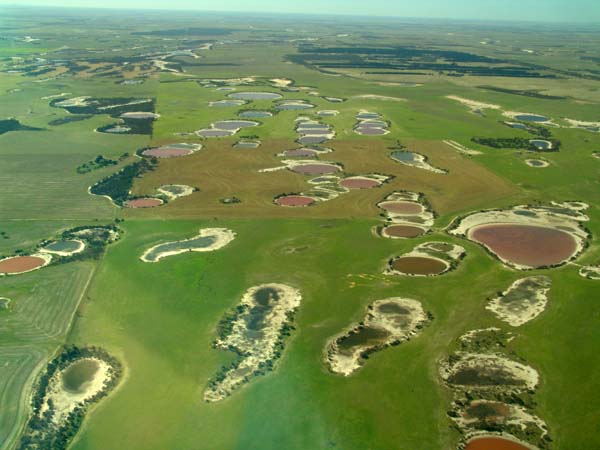 Flying
north it becomes increasingly more difficult to do much agriculture. Flying
north it becomes increasingly more difficult to do much agriculture. |
|
|
Coming closer to our next stop, Kalgoorlie, we started seeing huge mining pits of every size, shape and color. We were entering mining country. The town of Kalgoorlie started in 1893 when two men, Daniel Shea and Tom Flanagan stumbled across a large deposit of gold – 100 ounces of alluvial nuggets. Today the town has one of the largest open pit gold and nickel mines in Australia. It lies just next to the town where about 30,000 people live. In the heydays, more than 80,000 people populated the City. Looking from above, one can easily see that the whole City is quite dwarfed in comparison to the large mine which is over three kilometers long. |
|||
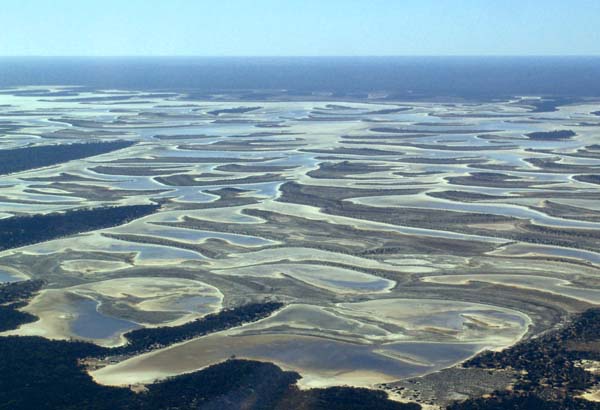 Rivers
and lakes on the map actually turn into salty flats. Rivers
and lakes on the map actually turn into salty flats. |
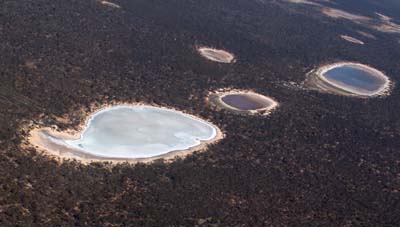 Nature
has it's own way of beauty. Nature
has it's own way of beauty. |
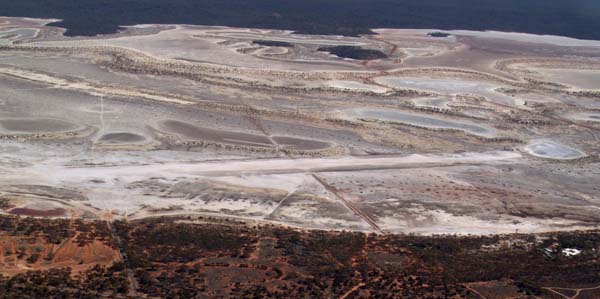 The
airstrip of Norseman is close to the shore of a salt lake. The
airstrip of Norseman is close to the shore of a salt lake. |
|
|
After sorting out which hotel was the one we asked her to drive us too, the taxi driver finally took us to the one where we indeed had the reservation. Some people are just hard headed like we are at times. At least she was honest; one of the drivers in Esperance took us “For a ride” which cost us far more than it should have been. After settling in for all of five minutes, we had a nice walk to the main street area. The afternoon sun displayed the historic buildings in all their majesty. At the Dome Café (an upscale Starbucks) we invited ourselves to enjoy an early dinner and do some people watching along the main street of Hannan in downtown Kalgoorlie. |
|||
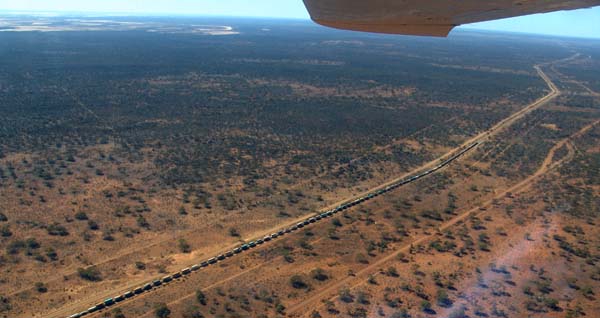 The
railway from Kalgoorlie in the direction of Sydney. The
railway from Kalgoorlie in the direction of Sydney. |
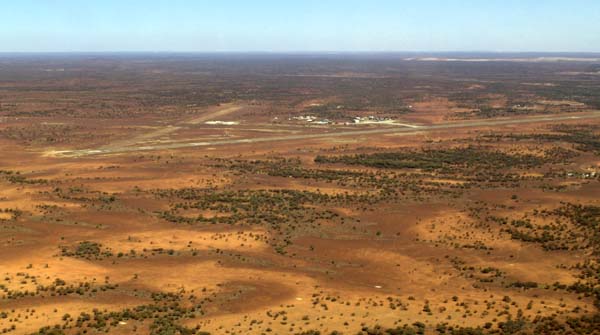 The
beautiful Airport of Meekatharra beckons customers. The
beautiful Airport of Meekatharra beckons customers. |
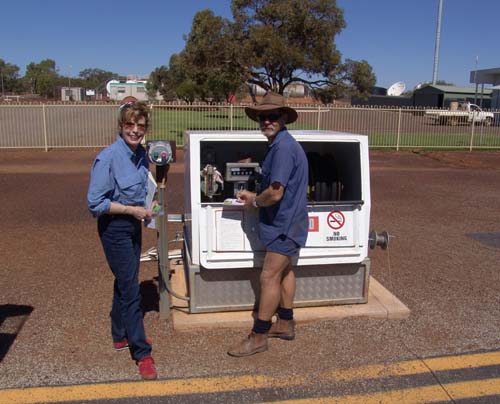 The
airport manager, Mel, has many jobs and even works on Sundays. The
airport manager, Mel, has many jobs and even works on Sundays. |
|
|
The next morning we left early for Newman. To our surprise the sky was overcast for over an hour giving us shade from the blistering sun. This is one of the major mining routes in this neck of the woods. While some are collecting gold, others find plutonium and in the north, iron ore is more predominent. The mother lode is often piled up nearby in pyramid fashion and resembles the piece of ground that is missing in the large hole that is being mined. |
|||
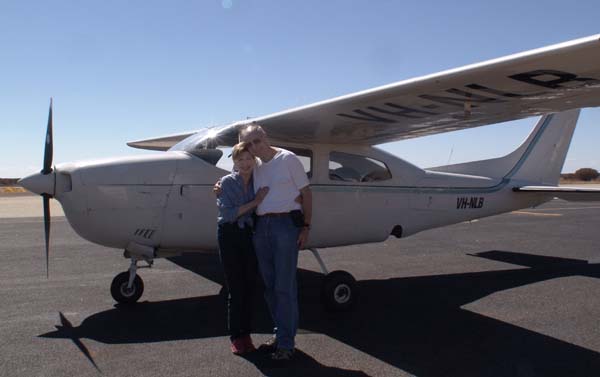 Mel
even works as photographer for passing tourists. Mel
even works as photographer for passing tourists. |
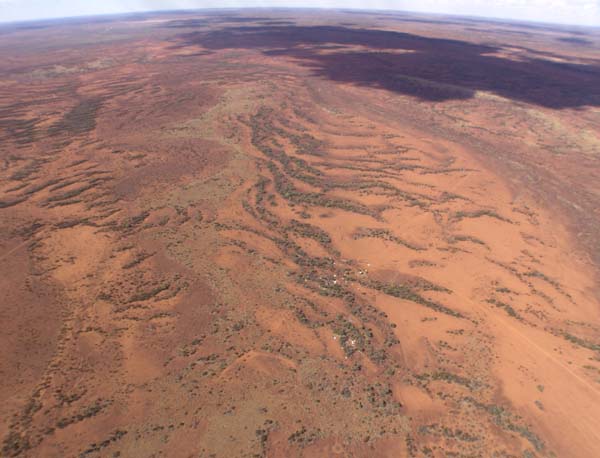 The
Small Sandy Desert even has it's residents. One can easily spot the junk
yard shown on the right. The
Small Sandy Desert even has it's residents. One can easily spot the junk
yard shown on the right. |
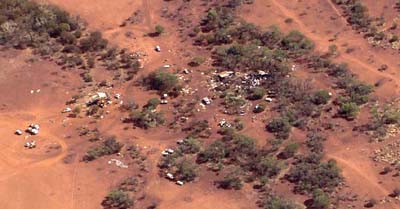 It
seems improbable
to discover this mess in such a remote area. It
seems improbable
to discover this mess in such a remote area. |
|
|
Meekathara was along our route and we briefly planned to stop, refuel and stretch our legs. It lies in a desolate and remote territory. Upon landing, the airport manager, Mel, also the fueling man, photographer, groundskeeper of colorful flower beds and spotless facilities apologized for having his gardens fenced to prevent the kangaroos from eating them at night. Despite the fact that it was Sunday, he was just as bright and cheery as his airport and grounds. We thoroughly enjoyed our visit. On the last leg to Newman, we started to play a little game of “Keeping the plane’s shadow over the road” and chase a lonely car below to break up the monotony and take our minds off the sweltering heat. Ueli found it amusing that he was sitting roadside on the right giving directions while Joan piloted the plane to accomplish this game. She became bored with this after not too long, as the road zigzaged every few minutes. We spotted an Aboriginal settlement and circled to take pictures from a high altitude so we would not be a nuisance. Then we came to one of our checkpoints, a roadhouse which was the only thing with human indication, besides the settlement. |
|||
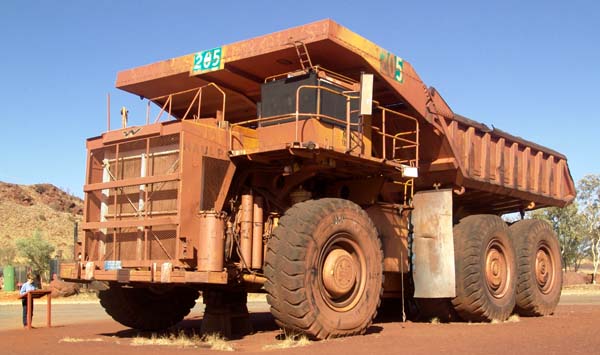 An
old
truck on display in Newman. Check Joan's size (left bottom corner). They
take 22 tons each load. An
old
truck on display in Newman. Check Joan's size (left bottom corner). They
take 22 tons each load. |
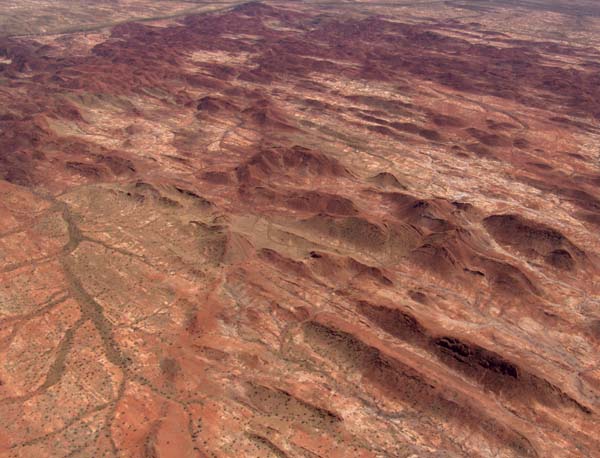 The
eastern foothills of the Hamersley Range, an area known to be very rich in
minerals. The
eastern foothills of the Hamersley Range, an area known to be very rich in
minerals. |
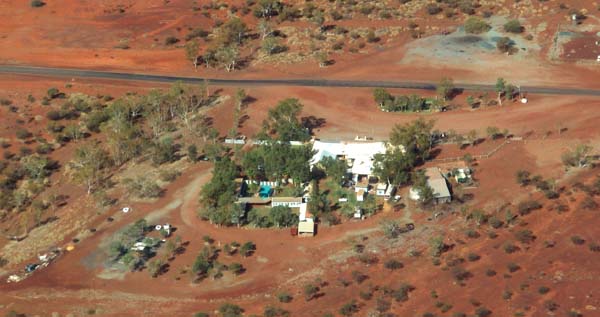 One
of the many Roadhouses along the immensely lonely roads of the outback. One
of the many Roadhouses along the immensely lonely roads of the outback. |
|
|
The runway of Newman soon came into sight and we set down nicely to complete this part of the journey. After checking cab fares, we decided that a rental car had to be less expensive than a taxi to and from the motel. We were again quoted an exorbitant price, but managed to knock $40.00 off the quote, thanks to AOPA. The husband of the woman, who managed Hertz, turned out to be an interesting fellow. Ueli talked with him about his mining job as an explosive expert and they went into great detail as Joan did the business transaction. At the small hotel restaurant, we were eating dinner and were approached by a young man asking whether we were the pilots of the Cessna parked at the airport. Apparently we had parked at their favorite spot (unmarked), although only one other plane was on the ramp. He asked if we or they could move the plane. We said no – we would be gone in the morning. Newman is so small that nothing goes unnoticed. The larger of the two open iron ore mines was just north of town and on the way out the next morning, we flew around it and shot many pictures – also of the smaller one which was southeast of Newman. They were the only interesting things about this place. One push of the throttle and we were out of there – for good. |
|||
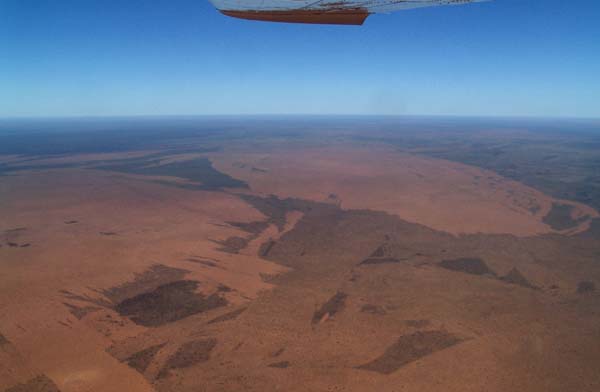 The
Great Sandy Desert reaches Alice Springs in the middle of the
continent. The
Great Sandy Desert reaches Alice Springs in the middle of the
continent. |
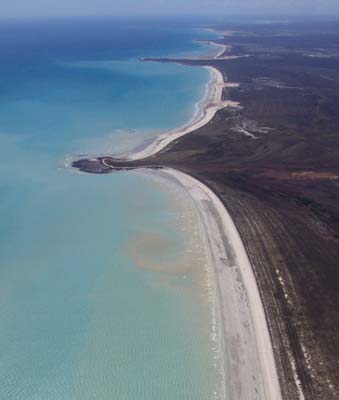 The
desert meets the Indian Ocean. Millions of years ago a meteor struck at this
location and caused a severe depletion of life. The
desert meets the Indian Ocean. Millions of years ago a meteor struck at this
location and caused a severe depletion of life. |
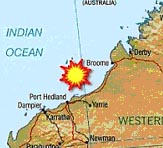 It
was exciting to see this area from the air and imagine how 251 million years
ago a comet (Bedout) hit the continent just offshore causing about 90% of
the marine life and 70% of the land life to become extinct. It
was exciting to see this area from the air and imagine how 251 million years
ago a comet (Bedout) hit the continent just offshore causing about 90% of
the marine life and 70% of the land life to become extinct.
|
|
|
It was a straight shot to Broome over more desolate country and desert. The charts indicated abandoned prospecting sights, and mountains. The most intriguing thing to us however, was the fact that the mountains marked on our charts were only a few hundred meters above the surrounding terrain. The charts depicted the altitude with plus – minus signs. We had to smile. |
|||
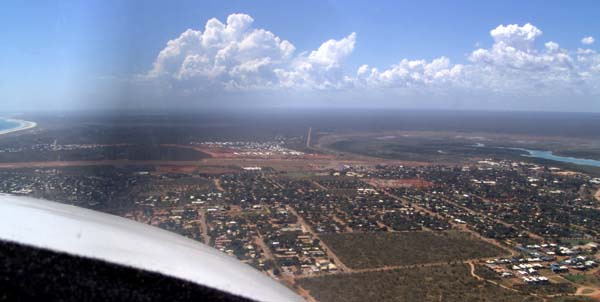 Broome
in sight. Time to slow down and relax for a while. Broome
in sight. Time to slow down and relax for a while. |
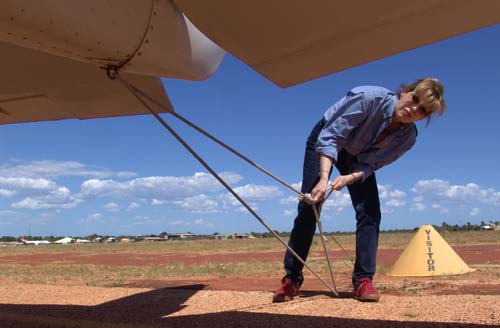 Making
sure the plane is well secured! Making
sure the plane is well secured!
In Broome, visitors are very welcome and the people are extremely friendly and helpful to road and air warriors.
|
||
|
Finally, after taking many pictures of whatever we saw, the Indian Ocean appeared on the horizon. At last we could fly the coastline into Broome. Both of us perked up – it had been a long haul over barren, yet beautiful country from the southern shores of Australia. Reaching Broome we were simply tired and needed more than one or two days in one place. We had slept in four different towns in five nights. It was time to chill out – in our dreams, as the temperature was over 100 degrees F. No matter, we were going to stay put, enjoy the beaches and do some casual sightseeing. |
|||
|
Don't hesitate to give us your impressions. You can contact us via wefly4fun2@aol.com |
|||
|
This page was last modified on 23. April 2005 |
|||